Subject Intent
At Ladygrove Primary School we believe that teaching and learning in art is important because it stimulates creativity, imagination and inventiveness. We aim to offer opportunities for children to:
– Foster an understanding and enjoyment of art, craft and design
– Experience a broad and balanced range of art activities
– Develop the ability to observe, investigate, respond to and record the world around them through a growing variety of forms and media
– Develop use of a range of tools, media and processes
– Express themselves and harness creativity
– Gain an understanding of the work of artists, crafts people and designers and apply this knowledge to their own work
– Study historical, cultural and religious art
– Enrich other areas of the curriculum through art practices
Pupils at Ladygrove are taught that art is about process; mistakes are opportunities to improve and develop their skills. Pupils are provided with opportunities to work in a variety of ways, including drawing, painting, collage, printmaking, 3D sculpture, and digital media, giving them well-rounded creative experiences.
Subject in EYFS
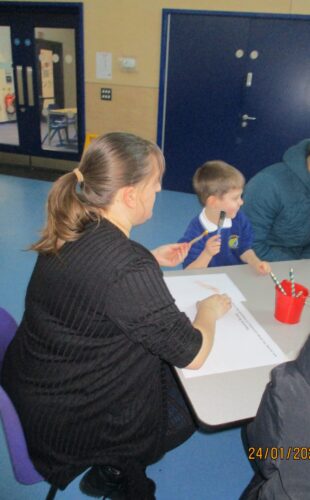
The Early Years curriculum lends itself to an integrated approach to learning. There is an emphasis on independence and self-initiated learning, which enables children to freely explore resources and pursue their own creative interests and talents, in addition to experiences and activities planned by teachers.
This child-led approach to learning means that children generate ideas through playful, hands-on, exploration of materials without being constricted towards a specific outcome.
By the end of Reception, pupils should be able to:
– Safely use and explore a variety of materials, tools and techniques, experimenting with colour, design, texture, form and function
– Share their creations and explain the processes they have used
Subject in KS1
Staff use a variety of teaching and learning styles in art lessons relating to the theme and children’s abilities and experiences. The exploratory aspect of art that was embedded in EYFS is still very much the focus in Key Stage 1. Sketchbooks are introduced to children, as a place to record individual responses to the world around them, through drawing/cutting/sticking/collecting.
During their time in KS1, pupils will learn to:
Recognise that ideas can be expressed through art
Experiment with an open mind
Explore materials in a playful and open-ended manner, trying out a range of materials and processes
Use particular materials/techniques for a given purpose
Describe what they think about the work produced by themselves and others
Know the names of tools and techniques
Know that different forms of creative works are made by artists, craftspeople, and designers from all cultures and times, for different purposes
Subject in KS2
Staff build upon what children have previously learnt in EYFS and Key Stage 1 and pupils begin to focus more on the development of their techniques, including their control and use of materials.
During their time in KS2, pupils will learn to:
Independently develop a range of ideas which show curiosity, imagination, and originality
Use sketchbooks as places to investigate, research and test ideas and explore personal creativity
Make instinctive, confident, creative choices during the making process
Select and effectively use relevant materials, tools and processes in order to create finished work
Regularly reflect upon progress, referring to their original ideas and intentions
Take photos and videos and experiment with digital media
Know and describe the work of historical and contemporary artists/craftspeople/designers and be happy to discuss and interpret the ideas and processes of these artists/craftspeople/designers
How we support SEND in Art
- Adapted equipment such as loop scissors, chunky pencils, and paintbrushes
- Wheelchair painting
- Assistive technology
- Large artwork to support gross motor development
- Multi-sensory curriculum
- Pre-teaching vocabulary
- Exploring and practising techniques
- Adaptive teaching
National Curriculum Link
National Curriculum – art-and-design
Planning Links and End Points
Access Art scheme
4 key principles that are implemented when teaching art:
Generating ideas
Making
Evaluating
Knowledge and Understanding
Assessment questions are used during art lessons through conversations with pupils. Examples may include:
Tell me about what you have made.
How do you feel about the end result?
What would you like to explore more of?
This enables pupils to constantly evolve, question and adapt their work to enable them to reach desired outcomes.
Knowledge and Skills Progression Document
Progression document 2024 – 25
Design and Technology and Art Long Term Plan 24-25
Parent Voice
Spring term 2025 sharing assembly with an art focus:
“Lovely interactive session.
—— really enjoyed sharing his art and I can see what he has learnt about expressing himself this half term.
Thank you”