Subject Intent
At Ladygrove Primary School and Nursery, our pupils are exposed to the creative arts consistently throughout their education, accessing and exploring opportunities in the areas of music, art and drama. This creative approach allows pupils to develop a love of music and increase their confidence and imagination. As a school we believe that “Where words fail, music speaks.” (Hans Christian Anderson). It is therefore vital that in this everchanging world in which we live in, children can express themselves and their identity through more than just words. Our pupils are consistently given opportunities to learn an instrument, sing songs from different genres and cultures, and perform to a range of audiences. Through discovering different genres, and the work of a variety of musicians, pupils leave Ladygrove Primary School with an enriched and widened view on the world.
Music Scheme
At Ladygrove we follow the Get Set 4 Education: Music scheme.

Subject in EYFS
Music within EYFS is used in an integrated, practical and exploratory way. Like all subjects, within EYFS, we use a child-led approach to musical learning, allowing the children to drive the focus on what we are learning.
Early Learning Goals:
-Sing a range of well-known nursery rhymes and songs
-Perform songs and rhymes with others, and – when appropriate – try to move in time with music
-Be confident to try new activities and show independence, resilience and perseverance
in the face of challenge
-Work and play cooperatively and take turns with others
-Show an understanding of their own feelings and those of others, and begin to regulate
their behaviour accordingly
-Give focused attention to what the teacher says, responding appropriately even when
engaged in activity, and show an ability to follow instructions involving several ideas or
actions
-Make comments about what they have heard and ask questions to clarify their
understanding
-Hold conversation when engaged in back and forth exchanges with their teacher and
peers
-Participate in small group, class and one to one discussions, offering their own ideas,
using recently introduced vocabulary
Subject in KS1
Pupils should be taught to:
-Use their voices expressively and creatively by singing songs and speaking chants and
rhymes
-Play tuned and unturned instruments musically
-Listen with concentration and understanding to a range of high-quality live and recorded music
-Experiment with, create, select and combine sounds using the inter-related dimensions of music.
Subject in KS2
Pupils should be taught to sing and play musically with increasing confidence and control. They should develop an understanding of musical composition, organising and manipulating ideas within musical structures and reproducing sounds
from aural memory.
Pupils should be taught to:
-Play and perform in solo and ensemble contexts, using their voices and playing
musical instruments with increasing accuracy, fluency, control and expression improvise and compose music for a range of purposes using the inter-related dimensions
of music
-Listen with attention to detail and recall sounds with increasing aural memory -Use and understand staff and other musical notations
-Appreciate and understand a wide range of high-quality live and recorded music drawn
from different traditions and from great composers and musicians
-Develop an understanding of the history of music
How we support SEND in Music:
- Widgit symbols (visuals)
- Adult and peer support
- Assistive technology
- Adaptive teaching
- Pre-teaching vocabulary
- Ear defenders
- Instruments in a quieter space or dampers used on instruments
- Sign language
National Curriculum Link
Planning Links and Assessment
At Ladygrove, we use a report approach assessment, supported by planning and assessment documentation through the Get Set 4 Music programme. By using this programme, the interrelated dimensions of music are weaved through different units, encouraging the development of musical skills as the learning progresses through listening and appraising, differing musical activities (including creating and exploring) and performing. This means that all pupils, regardless of their musical ability, can support one another in understanding concepts.
Any further information linked with a particular subject
Opportunities for Music and Performances
Children across KS1 and 2 are all involved with performances, as well as attending live concerts and putting on performances for the wider school community.
Music lessons led by musicians
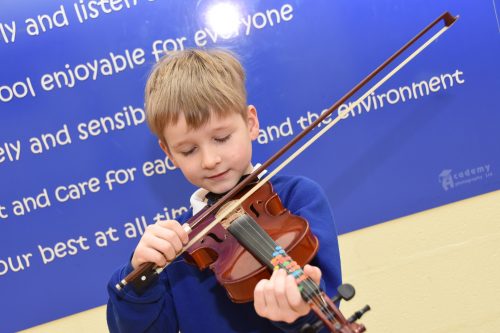
In Lower Key Stage Two we enable all children to experience learning an instrument by a local professional musician. We believe this enables the excitement of music to be captured, as the children can experience and gain an insight into a musicians’ life, as well as learn an instrument they might never have never seen before.
We have a range of music teachers available for individual music lessons, please contact [email protected] if you require further details.
Whole school assemblies
Whole school assembly times are recognised as a valuable opportunity to experience a range of music from different cultures and periods of time. In addition, we also have specific singing assemblies once a week. These are led by members of the teaching staff where we develop singing skills further.
Choir and school clubs
We believe that music enriches the lives of people, and so we wish to involve as many children as possible in musical activities. We have a school choir which we encourage all KS2 children to join. The choir meets on a weekly basis and, although its primary aim is to enable children to enjoy singing together, it also provides them with opportunities to perform, in public, on a number of occasions throughout the year.
Each year, the children are given the opportunity to participate, as a choir, in the YOUNG VOICES concert that takes place in Birmingham. This is an opportunity to perform, with many other school choirs, in the largest school choir concert in the world. The children experience performing with a full live band, backing singers and an internationally acclaimed conductor.
Music lessons
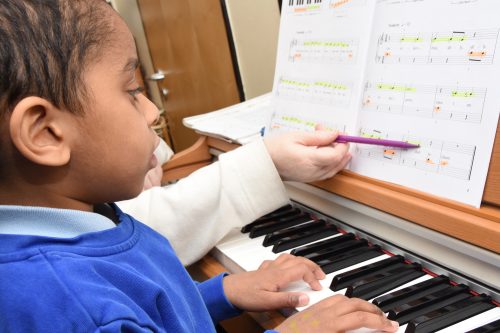
As a school we offer children in Key Stage 2 the opportunity to study a musical instrument with peripatetic teachers. Peripatetic music teaching is organised by the Local Authority’s Music Service, and this school has chosen to participate in the programme. Parents who want their children to participate in the scheme pay additional music lesson fees on a termly basis. These lessons are normally taught to small groups of children who have chosen to learn one of a variety of instruments, such as the guitar or keyboard. This is in addition to the normal music teaching of the school, and usually takes place during normal lessons, from which children are withdrawn for the duration of the instrumental lesson.
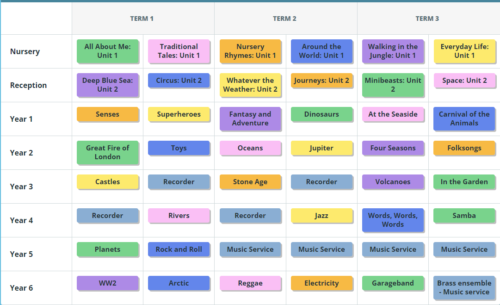
Knowledge and Skills Progression Documents
SMSC in Music

Through teaching Music, we can also develop children’s spiritual, moral, social and cultural development.
Spiritual Development
- To reflect on their own thoughts and opinions and those of others.
- To provide pupils with a supportive environment to express their feelings in a confident way.
- To provide opportunities for pupils to explore their own imagination, creativity and intuition when creating music.
- To explore how music has the power to influence and change behaviours, feelings, opinions and actions.
Moral Development
- To engage in critical discussions of musical performances.
- To reflect upon cultural or social references in music and respond to these sensitively and thoughtfully.
- To show empathy and understanding of different music styles.
Social Development
- To work collaboratively to create and present ideas/performances.
- To express opinions and feelings in a sensitive manner – being aware of the needs of others.
- To share ideas and listen to the thoughts and opinions of others, understanding that individuals can have different opinions.
- To provide opportunities for pupils to express themselves creatively.
- To develop performance skills and build confidence and resilience.
Cultural Development
- To explore music within their local area and wider community, as well as music across the world.
- To compare similarities and differences between music across the world.
- To develop a respect and appreciation for cultures around the world.
- To understand the way cultures around the world have contributed to the development of current popular musical styles.
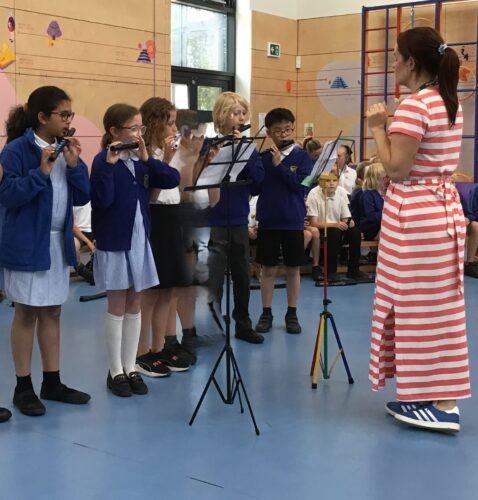
Year 5 put on a Toots performance for their families. They worked as a team to perform different songs and some children were brave enough to have solo parts.