Phonics at Ladygrove
Subject Intent
At Ladygrove, we love reading and we recognise that the reading ability of a child has a huge impact on how well they can access the whole curriculum. We therefore follow our school ethos that “Reading is the golden thread to learning” as we recognise that reading integrates into all areas of the curriculum and helps us to be the best that we can be.
We use the highly successful Read Write Inc Phonics programme to teach our children to become fluent, confident readers who are able to successfully comprehend and understand a wide range of texts. Our aim is for all pupils to develop a love of reading, a good knowledge of a range of authors, and be able to understand more about the world through the knowledge they gain from texts. We provide language-rich classroom environments and a curriculum where children are exposed to, and actively engage with, high quality language in varying forms in a meaningful, deliberate and engaging way.
Subject In EYFS
We use Read Write Inc. to teach phonics and graphic knowledge (common exception words and tricky words).
In Nursery, the aim is to increase children’s vocabulary through role-play, discussion, building sentences and using productive questioning. The emphasis is on developing children’s love of reading through enticing story and poetry times. When children are ready, they are taught the sounds of the individual letters, with the help of mnemonics and if ready they then move on to blending the sounds in words orally.
As soon as they start school, children in Reception begin letter sound correspondence. The children learn how to ‘read’ the sounds in words and how those sounds can be written down. They:
- begin by learning the Set 1 single letter sounds. (see Set 1 attachment below)
- learn how to orally blend, e.g. when they hear c..a..t they will be able to say ‘c, a, t and blend the sounds to say – cat.’
- learn how to Fred – talk (sound out) words containing the Set 1 sounds and read them on cards and in books, e.g. pat, can, rip
- move on to learning the Set 1 special friends (digraphs) once the single sounds are mastered – sh, ch, th, ng, nk, qu
- learn the first 6 Set 2 sounds (ay, ee, igh, ow, oo and oo.) and read words containing them.
Set 1 sounds Set 2 sounds Set 3 sounds
Please click on the link below to see how to pronounce the Set 1, 2 and 3 sounds correctly.
Read Write Inc.: How to say the set one, set two and set three sounds (youtube.com)
Fred Talk
We use pure sounds (‘m’ not’ muh’,’s’ not ‘suh’, etc.) so that your child will be able to blend the sounds into words more easily.
At school, we use a puppet called Fred who is an expert on sounding out words! We call it, ‘Fred Talk’. E.g. m-o-p, c-a-t, m-a-n, sh-o-p, b-l-a-ck.
Subject in KS1
In KS1 children will build on the work from Reception and move on to learning more complex sounds and read books appropriate to their reading level. They will recap the Set 1 sounds and special friends, learn the Set 2 sounds and also the Set 3 sounds and move through the story books. They will also focus on spelling words containing the sounds, using Fred talk as a strategy for spelling. In Year 1 daily sessions of RWI phonics last for one hour.
In Year 2 children take part in daily 45 minute RWI sessions in addition to their English lessons which focus on grammar and writing skills.
National Curriculum Link
Expectations of Progress:
Children working at the expected standard will be able to:
Reception:
End of Autumn Term: recognise all the single Set 1 sounds and can orally blend.
End of Spring Term: recognise the Set 1 sounds including the special friends (sh, ch, th, ng, nk, qu) and read Red storybooks.
End of Summer Term: recognise the first 6 Set 2 sounds (ay, ee, igh, ow, oo/oo) and read Green/Purple books
Year 1:
End of Autumn 1: read Purple Storybooks and recognise the first 6 Set 2 sounds – ay, ee, igh, ow, oo/oo
End of Autumn term: read Pink Storybooks; read all Set 2 sounds-ay, ee, igh, ow, oo/oo, ar, or, air, ir, ou, oy
End of Spring 1: read Orange Storybooks; read the first 6 Set 3 sounds – ea, oy, a_e, i_e, o_e u_e
End of Spring term: Read Yellow Storybooks; recognise all Set 3 sounds – ea, oy, a_e, i_e, o_e u_e, aw, are, ur, er, ow, ai, oa, ew, ire, ear, ure, ue, ie, au, e_e, kn, ck, wh, ph
End of Summer term: Read Blue Storybooks, recognise all Set 1, 2 and 3 sounds.
Year 2
End of Autumn term: recognise all sounds ; read Blue Storybooks with increasing fluency and comprehension (at least 60 words per minute)
End of Spring term: read Grey Storybooks with fluency (90 words per minute) and comprehension
End of Summer 1: Access RWI Spelling programmes/Access RWI comprehension
End of Summer term: Access RWI Spelling programmes/Access RWI comprehension
Parents can click on the links below to find videos that help with practise at home.
For children in Ditty, Red and Green Groups:
For children in Purple, Pink and Orange groups:
RWI Videos for practise at home Set 2
For children in Yellow, Blue and Grey groups:
Reading
Subject Intent
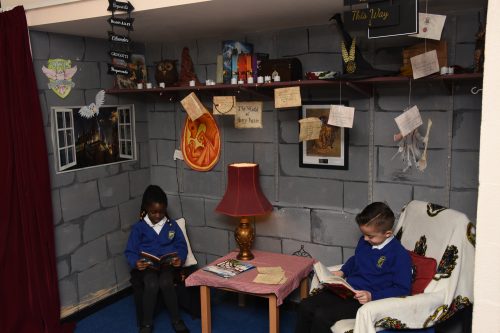
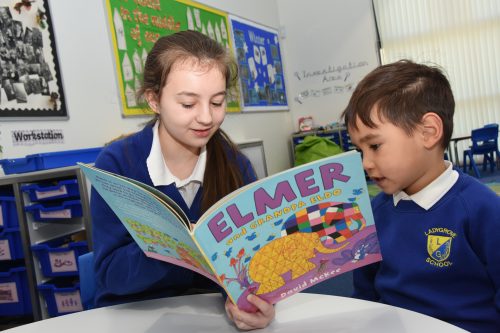
At Ladygrove Primary School and Nursery, we believe that ‘Reading is the golden thread to learning’. Our children have the opportunity to explore a range of texts matched specifically to their reading ability which is assessed through our book banding system. We strive to provide an engaging and meaningful reading journey for our children which encompasses reading at the heart of learning, supporting all children in reaching their full potential in preparation for their life ahead.
We wish for all our pupils leaving Ladygrove to be equipped with fluency in reading as well as a deepened understanding of vocabulary and context of the texts in which they read. Development We therefore place great emphasis on teaching children to read as early in their school careers as possible and fostering a love and pleasure for reading.
Subject in KS2
We endeavour for all children to have passed their Phonics Screen by the time that they enter KS2 and be reading complex texts at a good pace of at least 90 words per minute. Children will then be well-equipped to read with greater fluency and understanding of the text that they are reading. Throughout KS2, we enjoy developing children’s fluency through more challenging texts, matched for individual reading through our book banding system. Here, we ensure that children are listened to read regularly by an adult in school as well as encouraging children to read at least 3 times a week at home- children enjoy showcasing their reading journey through their individual reading diaries in which adults in school monitor and share.
From Years 4-6, children experience Whole Class Reading sessions where every child in the class shares the same text together. We find this experience ‘magical’ in developing a love and pleasure for reading whilst enhancing fluency, vocabulary, and inference in the text that they are reading, creating a shared reading culture in which our children thrive. Our children develop their knowledge of the Reading Strands through Reading VIPERS.
V ocabulary I nference P rediction E xplanation R etrieval S ummary
Reading VIPERS Progression Document
Reading VIPER progression document through year groups
National Curriculum Link
Any further information linked with a particular subject
Fiction Express
Fiction Express is an online reading platform that can be used to access from E-Books for different reading stages. Every pupil has a unique Fiction Express account to use at home and at school. Fiction Express is a very individualised reading programme that is designed to ensure children are questioned accordingly at various points in their reading; the results from reading activities and quizzes can be monitored by their class teacher.
Children also have access to the forum pages where they are able to safely interact with the authors of 3 live books monthly. Children can rate the chapters, respond to the proposed topics and participate in the development of stories of their choice.
If you do not have your child’s log-in details, please contact your child’s class teacher.
Reading at Ladygrove- letter for parents
Writing
Subject Intent
At Ladygrove Primary School and Nursery, our pupils have the opportunity to aspire to be confident and fluent writers. We are passionate in delivering writing opportunities that pull on the children’s interests to encourage children to write expressively for a range of different purposes and audiences. We endeavour to support the writing process with engaging the children in cross-curricular stimulus for writing that encounters speaking and listening opportunities including role play, drama, and contextual learning that we believe provide children with the tools and resources to become successful and passionate writers.
Our pupils leave Ladygrove having experienced exciting and initiative writing experiences built from a wide vocabulary range demonstrated though challenging and meaningful reading. As well as vocabulary, children are supported in the accuracy of grammar and spelling through weekly grammar lessons embedded into the sequence of writing to ensure that children can make explicit links in accuracy of their writing and in the curriculum as a whole. Children at Ladygrove take great pride in their writing and learn to write in a Cursive font from Year 2 once they have a secure and confident understanding of letter formation.
Subject EYFS
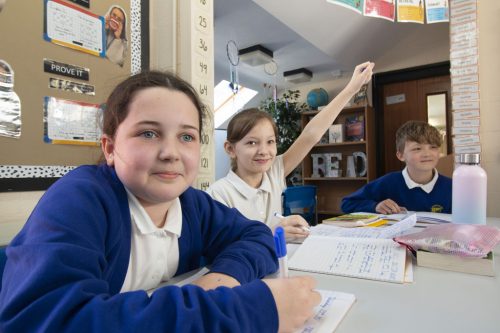
In EFYS, children are entered into the writing phase with engaging, cross-curricular approaches that excite and enthuse children to become young writers. When ready, children will have regular opportunities to write in their Read Write Ink session as well as taking part in two adult led writing activities a week. During these sessions, children are encourage to independently use support such as sound mats and working walls to aid writing along with being encouraged to use words that are not phonetically decodable (Red Words) that are displayed in the classroom.
Children in EYFS are taught letter formation using acronyms from their RWI sessions and are encouraged to practise letters during 3 handwriting sessions additional to their writing sessions. In EYFS, we particularly value the importance of fine motor skills- children have two sessions a week based around developing fine motor skills through creative approaches such as ‘dough disco’. EYFS staff provide children with regular opportunities to write independently through the use of the ‘writing table’- children often link their independent writing to their class topic.
Subject in KS1
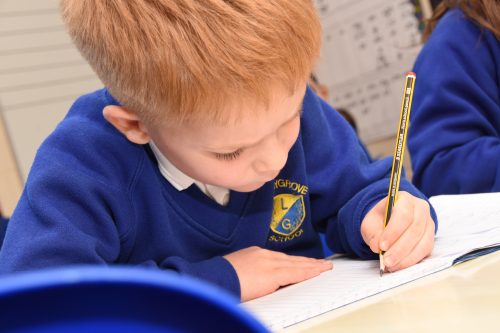
In KS1, we value that pupils are given opportunities to write or various purposes, understanding that writing is essential to thinking and learning and enjoyable in itself. Pupils are taught to use writing as a means of developing, organising and communicating ideas- writing is built from speaking and listening activities including drama and role play, rehearsing sentences for writing we feel integral to support, encourage and scaffold the writing process. In KS1 our English curriculum offer is taught through immersion in high quality texts to develop our learners to have fluency and depth of understanding, linking reading, grammar and cross-curricular concepts to provide high quality writing sessions. Across the year, our children have varied writing experiences to ensure that they have exposure to a range of writing genres within fiction and non-fiction; we encourage children to link vocabulary from their reading and topic and place strong emphasis on vocabulary. Visual resources and pictorial scaffolds are provided to support children’s writing along with regular handwriting sessions to practise letter formation- when children have completed their Read Write Ink sequence, they will be taught to write in Cursive joins ready for their transition to Key Stage 2.
Subject in KS2
Building from prior experiences in Key Stage 1, we thrive in developing children’s writing experiences in both fiction and non-fiction and plan regular opportunities for children to write for a range of purposes, across a variety of genres. We aim to link/promote writing experiences from first-hand or cross-curricular approaches, building from children’s interests to develop a love for writing. We also enjoy developing a ‘writer’s voice’ in the work that children produce, encouraging children to draft, proof-read, edit, and publish writing. Children are given regular opportunities during the writing process to proof-read (changes to writing are made using a purple pen) and edit and re-draft (black pen). By doing this, children enjoy and take pride in the process and development of their writing and are able to share and discuss the effectiveness of their writing at different entry points.
Throughout this successful writing journey, children are encouraged to think deeper about their choice of vocabulary to enhance meaning or create effect in writing as well as selecting appropriate vocabulary, organisation, and language to suit a given audience/purpose.
Planning Links and End Points
In Years 1-6, children complete Chance to Shine pieces of writing which showcases their independent writing. Within independent writing, children use resources and the sequence of lessons prior to the write to deepen their ability to write for a select purpose and purpose.
It is important that when writing independently, children draw upon their writing sequence to use devices such as writing plans and scaffolds to support their independent writing and show enjoyment and resilience in their learning.
Writing is taught through a clear, progressive sequence of lessons, embedding spelling, punctuation and grammar into daily sessions; children are taught a specific grammar/punctuation focus at the beginning of a writing unit and are expected to embed this learning and new skill into their independent writing. Children therefore explore and unpick specific grammar links to writing in which they then aspire to include to enhance the effectiveness of writing.
Teachers then assess independent writing using the end of year writing targets and expectations stemmed from Grammarsaurus- every child has a grid with their end of year writing targets/expectations and teachers use this throughout the writing process to highlight devices that are evidence in writing and can therefore hold conversations with the children to ensure realistic and approachable targets can be set individually for children to achieve in their next independent write.
How we support SEND in English (Reading and Writing)
- Assistive technology
- Dictation using a headset
- BBC Bitesize Dance Mat Touch typing
- Laptops and iPads
- Purple Mash
- Reading Pens
- Immersive reader
- IDL
- Colourful Semantics
- Widgit symbols (visuals)
- Pre-teaching vocabulary
- Alan Peat’s sentence types
- Barrington Stoke books – dyslexia friendly
- SNIP Spelling intervention
- Precision teaching (high frequency words or phonics sounds)
- Read Write Inc Phonics interventions
- Letter join to support handwriting
- Write Dance intervention