Subject Intent
The National Curriculum suggests ‘a high-quality history education will help pupils gain a coherent knowledge and understanding of Britain’s past and that of the wider world. It should inspire pupils’ curiosity to know more about the past’
At Ladygrove, we aim to deliver a high-quality history education that enables learners to gain an understanding of our local heritage, Britain’s past and that of the wider world. Our lessons inspire children’s curiosity to know more about the past.
Children, through history, are encouraged to ask perceptive questions, sift arguments, weigh evidence, think critically and develop perspective and judgement.
Progression at Ladygrove is linked to developing key skills in:
Chronology, Historical Enquiry and Interpretation of History.
History at Ladygrove enables our learners to be proud of their local heritage, develop a sense of their own identity and an awareness of the challenges and changes within their local area.
Our curriculum seeks to provide our learners with a growing understanding of the complexity of people’s lives, the process of change, equality and diversity within societies and develop an understanding of the relationships between different groups of people.
We believe that a solid grounding in historical enquiry skills and knowledge, supports our learners to address wider social issues, through fostering a greater appreciation for the contribution of diverse peoples and cultures in society. Children at Ladygrove gain a sense of belonging and pride in their local, national and global heritage; understand how thinking about continuity and change in the past can add to our knowledge and understanding the world we live in today.
At Ladygrove, we strive to go further with our History curriculum and use this subject to help us to address wider social issues.
We explore three Intent threads within our History topics:
Migration/Diversity; Heritage; Continuity/Change.
Using these threads, our intention is to enable our learners to foster a greater appreciation of the contribution of diverse peoples and cultures in humanity’s collective history. To gain a sense of belonging and pride in their local, national and global heritage. Understand how thinking about continuity and change in the past, can add to our knowledge and develop an understanding the world we live in today.
This builds empathy and understanding with all peoples and their contribution to our lives today and develops in our learners: a sense of equality and social justice.
Subject in EYFS
In the Early Years Foundation Stage, History provides children with the opportunity to develop their Early Learning Goal: Understanding the World, to begin to recognise how things and people change over time. Children begin to make sense of their own life-story and their family’s history.
History is taught in Reception as an integral part of the topic work through child-initiated and adult led activities. The children are given the opportunity to find out about past and present events in their own lives, and those of their families and other people they know. In the Foundation stage history makes a significant contribution to developing a child’s understanding of the world through activities such as looking at pictures of famous people in history or discovering the meaning of new and old in relation to their own lives.
Books are an important part and key feature in supporting the children’s growing knowledge of the Past and Present, through making comparisons and contrasting characters from stories, including figures from the past. The children develop their understanding of the world through settings, characters and sharing stories to understand the past and make links to the present day.
During their EYFS stage at Ladygrove, children are given opportunities to talk about their lives of the people around them and their role in the community/society. They comment on images of familiar situations in the past and begin to know some similarities and differences between things in the past and what is happening now, drawing on their own experiences and what has been read in class.
The reformed Early Years Framework that was implemented in September 2021 sets out that History will continue to be taught under the Early Learning Goal: Understanding the World and the key strand: Past and Present.
Subject in KS1
During Key Stage 1, pupils learn about people’s lives and lifestyles. They find out about significant men, women, children and events from the recent and more distant past in Britain and the wider world. They listen and respond to stories and use sources of information to help them ask and answer questions. They learn how the past is different from the present.
Children begin to sequence events into chronological order and use artefacts, to begin to develop historical enquiry skills and learn to develop confidence in describing their similarities and differences.
Drama is used as a medium for understanding significant people and events from the past, which fosters empathy and understanding in our learners.
Subject in KS2
In years 3 to 6, pupils learn about significant people, events and places from both recent and more distant past. They learn about change and continuity in their own area, in Britain and in other parts of the world. Children in KS2 link their historical learning to their prior knowledge by placing their current studies on a time line in relation to other historic periods already covered during their time at Ladygrove.
Further developing their skills as historians, our KS2 learners begin to look at history in a variety of ways, for example from political, economic, technological and scientific, social, religious, cultural or aesthetic perspectives. They use different sources of information to help them investigate the past – using dates and historical vocabulary to describe events, people and developments. They also learn the very important point: that the past can be represented and interpreted in different ways depending on the historical persepective being studied. They discover beliefs, behaviour and characteristics of people/societies being studied and compared these with another historic period to recognise that not everyone shares the same views and feelings.
Assessment
In History we use various tools to support us with assessment. At the start of each History topic pupils are presented with ‘The Big Question’. This is an overarching question that brings together the learning within that topic. Pupils then revisit this question throughout their topic adding key knowledge they have learned.
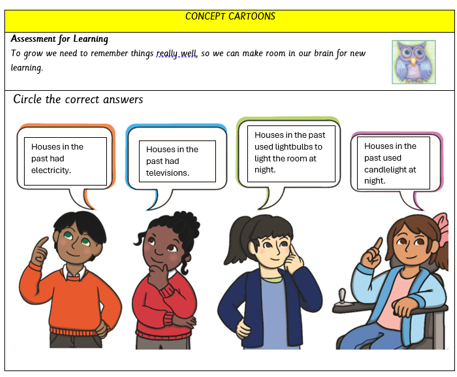
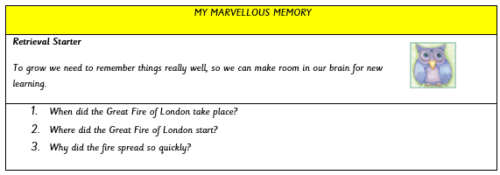
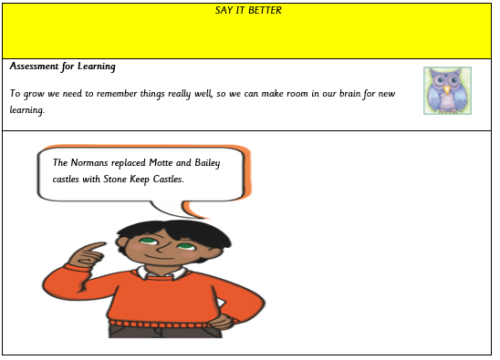
We also use a variety of Assessment for Learning tasks throughout every History topic that allow our pupils to think deeply about their learning and revisit prior knowledge. These tasks include Marvellous Memory, Concept Cartoons, Positive Minus Interesting, Say it Better and Word Maps.
How we support SEND in History
We use adaptive classroom teaching to meet the needs of all our learners. We utilise the following resources to support all pupils in meeting the expected outcomes for History:
- Adaptive teaching
- Assistive technology
- Visual displays and word mats
- Widgit symbols (visuals)
- Visual timelines
- Audio and video recordings
- Handling artefacts
- Educational visits
National Curriculum Link
The National Curriculum is the basis for all planning and long-term planning, to ensure that there is full coverage of the History curriculum across all key stages. We ensure that there are opportunities for children of all abilities to develop their skills and knowledge in each unit. We build planned progression into the scheme of work, so that the children are increasingly challenged as they move up through the school.
The children undertake broad and balanced schemes of work, that take into account all abilities, aptitudes and physical, emotional and intellectual development. Through History, the children learn a range of skills, concepts, attitudes and methods of working.
We use a cross-curricular approach wherever possible, interweaving history with other subject disciplines, in order to develop our learner’s knowledge and core subject skills.
Planning Links and End Points
By the time children leave Ladygrove, our intention is for them to have had opportunities to develop cultural capital through visits to historic sites and access to experts in the field of history. We wish for them to have a solid grounding in continuity and change across the British Isles and a broad understanding of the world they live in today through developing knowledge of the past.
We hope that their history education supports them towards developing empathy to others, sympathetic to social justice a greater appreciation of the contribution of diverse peoples and cultures in humanity’s collective history.
Knowledge and Skills Progression Document and Overview
26-27 Ladygrove History Knowledge and Skills
26-27 Ladygrove Curriculum Map History