Our Intent in Mathematics
At Ladygrove Primary School and Nursery, our pupils have the opportunity to explore concepts and build on prior learning, taking small steps to achieve greater understanding along their mathematical learning journey. We endeavour to provide a Mastery Curriculum to support all children in reaching their full potential in preparation for Secondary school and adult life. Our pupils leave Ladygrove Primary School and Nursery with a confidence in Mathematics, a joy of learning and are well-equipped for the challenges that lie ahead. As part of Mathematics, we celebrate TOUGH TORTOISE to build resilience when faced with a challenge and WISE OWL to revisit prior learning, promoting knowing more, remembering more.
Our pupils leave Ladygrove Primary School and Nursery with mathematical confidence, a joy of learning and are well-equipped for the challenges that lie ahead.
We believe our pupils should have:
- Confidence in Mathematics so they are able to express themselves and their ideas using the language of mathematics;
- An understanding of how mathematics is used beyond the classroom in everyday life and the world of work;
- A passion for mathematical learning;
- An awareness and understanding of relationships within mathematics and the ability to generalise;
- An awareness of the range of strategies that they can use as they apply their knowledge, skills and understanding to solve complex problems in a range of different contexts;
- The ability to persevere and be resilient in their everyday learning.
Implementation
At Ladygrove Primary School, we use the ‘White Rose’ material to inform our daily teaching and learning. Our Mathematics uses the CPA approach:
C = Concrete (using physical objects to solve calculations and problems)
P = Pictorial (using drawings to solve calculations and problems)
A = Abstract (solving Maths calculations problems using only numbers and symbols)
Whilst we use White Rose as an initial driver, at Ladygrove, we understand the importance of ensuring retention in Maths and using quality formative assessment to review our planning and teaching when necessary.
We recognise the importance of supplementing the White Rose scheme of work with other high-quality resources such as Nrich, NCTEM, Convince Me cards and I See Reasoning to encourage deeper mathematical thinkers.
Ensuring instant recall in Maths is crucial for our children to become successful learners so through the implementation of fluency recap activities, children are regularly given the opportunity to revisit core concepts and allow misconceptions to be regularly addressed. Through the use of ‘My Marvellous Memory’ activities, pupils are required to think back to prior learning to ensure their fluency is continually developing, allowing them to know more and remember more.
At our school, pupils study Mathematics daily, allowing them to develop their understanding of core aspects of the curriculum: number, calculation, fractions, geometry, algebra, measure and statistics. These lessons are structured to build on fluency, reasoning and problem-solving skills, allowing children to become resilient, confident and independent learners. We use the acronym RICC (Read, Interpret, Calculate, Check) when problem solving to provide pupils with reference points to follow in order to encourage logical and systematic thinking. Twice half-termly, explicit problem solving lessons are taught to focus on one of the four different types of problem solving: logic, finding all possibilities, worded problems and patterns and rules. These lessons provide all pupils with the skills and understanding of how to approach specific problem types, allowing them to develop strategies to solve complex problems.
Pupils in Key Stage 1 and Lower Key Stage 2 are explicitly taught times tables and are allocated time to practise their multiplication skills. This approach aims to develop knowledge and fluency in their multiplication and division facts. Through the use of Cracking Times Tables and Times Tables Rockstars, pupils develop their enthusiasm and enjoyment for times tables, which in turn supports them in all areas of Maths. This rigorous support continues into Upper Key Stage 2 for those pupils who are not yet fluent in their times tables.
Impact
At Ladygrove, our teaching of Mathematics aims to provide pupils with a curriculum that allows them to develop the skills, independence and resilience to know more and remember more. Every term, we measure the impact of the children’s progress using White Rose Maths summative assessment in Years 1, 3, 4 and 5 and past SATs papers in Years 2 and 6. This allows us to track pupils’ progress and make any alterations to future planning to improve the learning of our pupils.
Formative assessment is ongoing and takes place throughout Maths lessons daily. We regularly listen to the pupils’ voice to inform our planning and measure the impact of our teaching. We aim for our children to be able to articulate their learning, providing clear explanations and key mathematical vocabulary in their answers.
By the time the pupils leave our school, we aspire for them to be resilient, independent learners who have the knowledge and understanding of a range of strategies and resources to support them in facing new challenges. We aim for them to be fluent in key skills and mathematical concepts that will not only equip them for a successful start to Secondary School but also to become a successful, life-long learners.
Mathematics In EYFS
Here at Ladygrove Primary School and Nursery, we see Mathematics as a beautiful, creative subject where we meet many challenges and learn from our mistakes. Our curriculum starts the minute children enter Nursery and includes rich opportunities for children to develop their spatial reasoning skills across all areas of mathematics including shape, space, and measures.
Opportunities for mathematics learning – linked with EYFS profile and key early concepts/skills, as appropriate:
In the CPA approach (a sequence of learning using Concrete, Pictorial and Abstract), children explore new maths concepts in a concrete way using real-life situations and objects and use mathematical representations, such as counters, bar models or a ten-frame, in order to help them make sense of abstract numbers and symbols. We are passionate about empowering pupils to see ‘inside’ a number to develop number sense through ‘subitising’. We also value the EQUAL sign and link this to the early foundations of algebra.
Mathematics in KS1
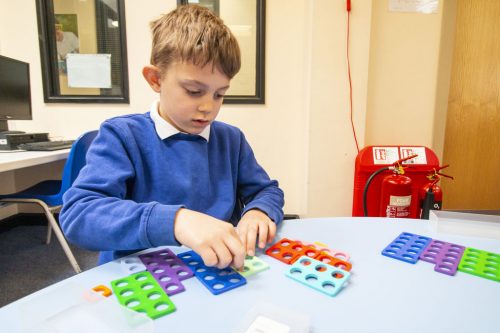
In Key Stage 1, we build on the foundations of Early Years and provide rich mathematical activities linked with children’s topics and environment. We use concrete apparatus and begin providing children with opportunities to think deeper in Maths through solving problems.
Mathematics in KS2
Building from Key Stage 1, here we enjoy developing the children’s mental mathematics, especially in their multiplication recall. We also enjoy our fluency journey, as well as supporting children to think deeper about Maths through Reasoning and Problem Solving. Here, we focus heavily on the use of vocabulary to enable pupils to explain and teach their Maths understanding to others. This helps to embed the learning and supports children in remembering mathematical concepts.
How we support SEND in Maths
- Concrete resources (dienes, counters, place value sliders, numicon, rekenreks)
- White Rose Maths Digital Tools
- Pictorial representations (bar models, tens frames, Hungarian tens frames, fraction walls, multiplication grids, hundred squares)
- Pre-teaching vocabulary
- Daily Minute Maths to support fluency
- Numbots App
- IDL
- Cracking Times Tables
- Times Table Rockstars
- Subitising
- Number Stacks intervention
White Rose App intervention
National Curriculum Link
National curriculum – Mathmatics.pdf
White Rose Primary Mathematics Scheme
In Year 1 to Year 6, we follow the Mastery approach using the White Rose Maths programme. Within White Rose Maths, children deepen their understanding of mathematical concepts, becoming more confident and competent and ready to face new challenges. It is important that pupils are secure in their knowledge and understanding across all mathematical areas and show resilience in their learning.
Mathematics is taught through three main types of questioning: Varied Fluency, Reasoning and Problem Solving. Children explore and unpick mathematical concepts in depth, working through differentiated work but within mixed ability grouping. This means that all pupils, regardless of their mathematical ability, can support one another in understanding concepts.
Planning
Planning overviews from White Rose Mathematics Scheme of Work:
Reception White Rose Hub Yearly Overview
Year 1 White Rose Hub Yearly Overview
Year 2 White Rose Hub Yearly Overview
Year 3 White Rose Hub Yearly Overview
Year 4 White Rose Hub Yearly Overview
Year 5 White Rose Hub Yearly Overview
Year 6 White Rose Hub Yearly Overview
Cracking Times Tables
Cracking Times Tables is used in Years 3 and 4 to develop fluency in times tables.
Pupils are provided with opportunities to practise their tables in school daily and their weekly progress is assessed on a Friday. Pupils are also asked to practise their current level as part of their weekly homework.
Certificates are awarded during assemblies when children reach milestones in Cracking Times Tables.
Times Tables Rockstars
Pupils are encouraged to practise on Times Tables Rock Stars is part of their weekly homework in Key Stage 2.
Every pupil has a #TTRockStars account to use at home and in school. Times Tables Rock Stars is a carefully sequenced programme of daily times tables practice.
Termly tournaments take place across school and within year groups so it is important that every child plays regularly.
Children can practice in the ‘Garage’, earn their rock status in the ‘Studio’ or compete against their peers in the ‘Arena’. Pupils can even challenge their peers to a battle in ‘Rockslam’ or play against children from all around the world in ‘Festival’ mode!

Knowledge and Skills Progression Documents
Progression in CALCULATION
Progression in REASONING
Progression in Place Value
Progression in Fractions
Progression in Algebra